
Although the term, vocology, was presented as early as 1989, it remains mysterious to many in the field of singing. In the broadest sense, it is the study of vocalization. The field considers human vocalization, of course, but also examines animal sounds such as bird tweets & whale songs, and I supposed anything that could produce a sound that mimics a vocalized sound (e.g. robot-produced?). Further, in this broadest sense, anyone who studies or considers vocalization could be considered a vocologist.
Narrowing the focus to the field of singin, we can consider these very basic questions:
- Do you believe in the integration of science and practice in the field of singing?
- Do you believe in solid clinical practices and continuing education and refinement of your practice?
- Do you honor the beauty/power/variety/etc. of the human (or other) voice and those who produce sounds?
If you answer yes to all three questions, then you are either a vocologist or are a great candidate to become one. A vocologist is poised to occupy that delicate space in the field of singing that yearns for evidence-informed approaches. A vocologist is an ideal person to have on a research team, as a colleague in a clinical practice, or as a research subject. Vocologists usually have a specialization in one sub-field related to singing and know their professional limited. Research that is designed and conducted by groups of people who claim all three roles of research, teacher, and singer will not produce the richness of thought, design, and execution that collaborative projects promote with carefully curated teams. Yes, these projects may be more difficult to organize, but that is no excuse!
Advice to researchers: admire someone’s voice? Ask them to help with the methodology! Or ask them to participate as a subject and invite their friends.
Advice to clinicians: remember that you are the most natural conduit between research and the performers. You must continually refresh your knowledge base and forge relationships with others who have knowledge that you’re lacking. You don’t have to know it all. You don’t have to solve every problem. You do need to know who you can call for back up!
Advice to singers/students: have an informed opinion – about the singing you want to do, about the genre to which you are best suited, about what you’re being taught, and about what you’re not being taught. At the end of the day, your voice is your responsibility, and if you’re a professional (or wish to be one someday), you need to advocate for your needs and desires.
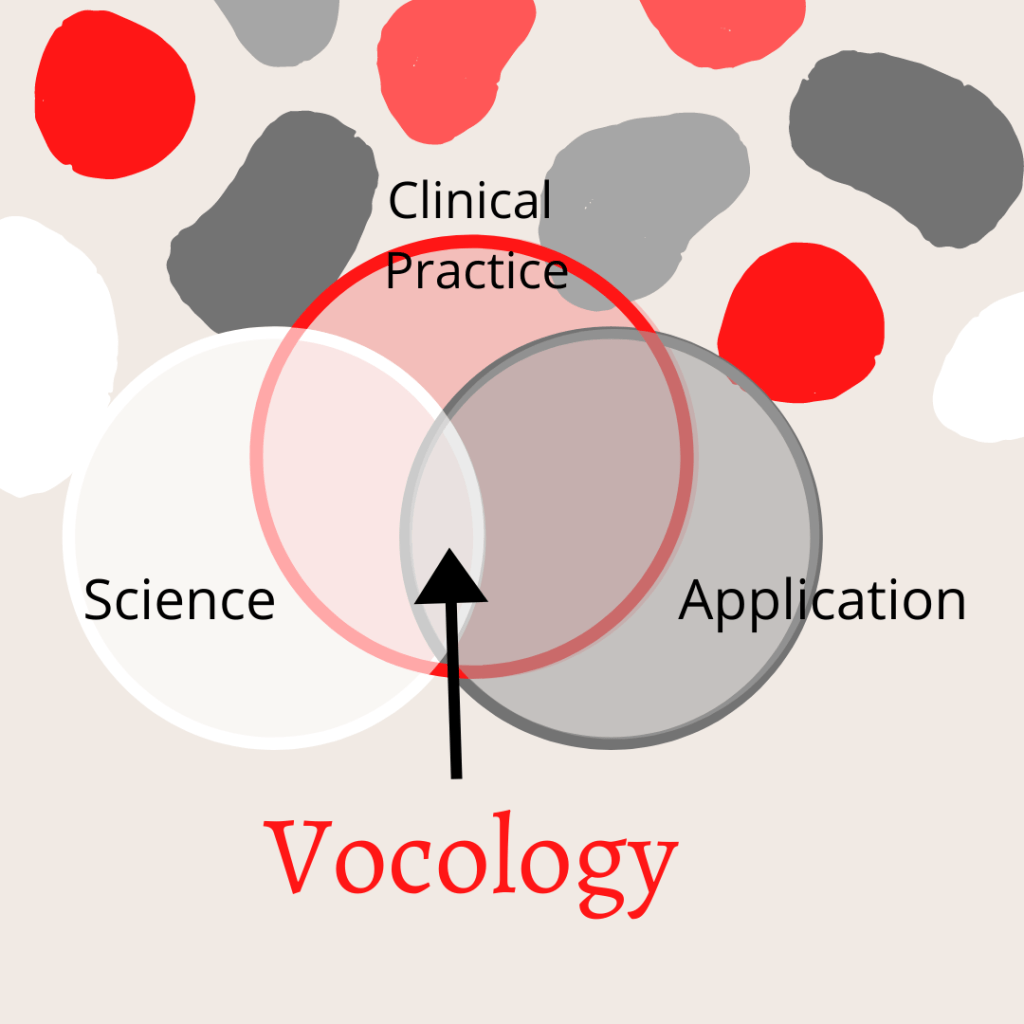
So who is a vocologist? Well, people will argue over who is or isn’t qualified to hold that designation. I happen to have a vocology certificate from the National Center for Voice and Speech, and other programs are popping up across the U.S., but I’m not sure if we have agreement on who, specifically, is a vocologist. So I offer you this image I created this morning and boldly state the following:
I hold space amid the science, clinical practice, and professional output related to classical singing. I am an evidence-informed vocologist. To answer my title question… we can be both narrowly focused and broad depending on the context and how our skill set interacts with the needs of the situation.
 Evidence Informed singing