Before diving into a heavily researched blahbitty blah of why this blog is called Evidence-Informed Singing, not Evidence-Based Singing (my previous term), let’s just quickly unpack some OED definitions of these adjectives.
-based
This adjective is still widely in use with regard to Evidence-Based Medicine (EBM) and applications to other fields. This term was brought forward by Sacket et al. in 1996. I think the EBM framework has been huge in empowering patients to take ownership of their health concerns. However, more recent research suggest that this model has theoretic & practical limitations, and many have abandoned it for Evidence-Informed Practice. This aligned with my intuitive, somewhat uninformed, discomfort with the term, so I have shifted my focus from Evidence-Based Singing to Evidence-Informed Singing.
Back to the dictionary…
- having as a foundation, a fundamental principle, or an underlying basis
- having as its main or most important element
Ok, so to me… this puts evidence on a lonely, sad pedestal. There’s only room for one thing at the top. It’s singular. This is limiting and could easily play into a fixed mindset when consuming information. No, I didn’t look much beyond OED for definitions, but you’ll find other definitions that point to this adjective in similar fashion.
I lied: a simple google search gives one definition of the verb as situating from a central point of operation.
Evidence. Evidence. Evidence.
Who’s evidence? Which evidence will we use as our central point of operation, our central location of “fact” consumption? This creeps me out. It feels subversive.
-informed
I have to admit, my investigation of this word has me geeking out a bit. Although not presented as synonyms, part of the adjective’s definition includes these loverly words:
Knowledgeable
Enlightened
My favorite definition of this adjective from the OED is (more or less exactly): influenced by knowledge of or by understanding of a particular situation or subject.
This word is roomier and more inclusive. It allows for growth and development. It requires understanding. It demands a meaningful context.
I don’t know if I’ll ever achieve anything close to an enlightened state on anything… Lord knows I have more to learn about living my life, raising a family, performing, teaching, and researching topics that interest me, than I can possibly accomplish in my lifetime, but I hope to be authentically knowledgeable on something at some point before I become irrelevant… or dead… or both.
Whoa, that turned a bit dismal… which is inconvenient… because I’m ready to end this post here…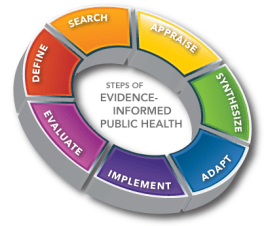
Alright I’ll leave you with one more thing. It’s a wheel from the public health sector. I love wheels, and in my interpretation – which could be completely naive, since I’m only at the beginning of my investigation of evidence-informed practice – of steps presented on a wheel is that you can enter from anywhere on the wheel and pick up understanding, nuance, and actions along the path. You can also do multiple rounds on the wheel to really dig down into an issue and creatively approach various issues.
Say you’re already in the implementation phase of a teaching tool. You can evaluate the implementation and move on to re-defining needs/goals and then continue forward from there. I’ll be spending time with this wheel as I continue to inform and hone my own perspective of this framework.
 Evidence Informed singing